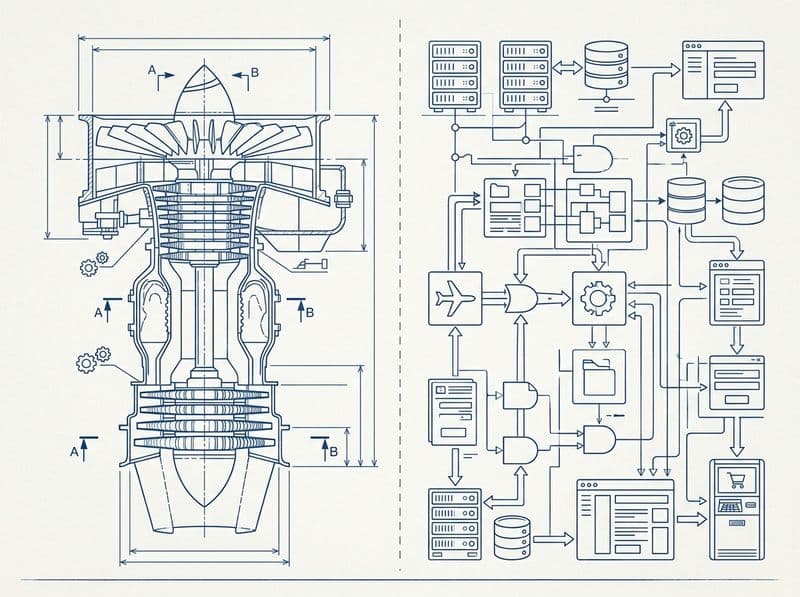
I have a tongue-in-cheek soundbite I like - "You want the progressive to design your aircraft ticketing system, but you certainly want a conservative maintaining the engine".
I find myself repeating it a lot lately, and it explains almost everything about why software companies struggle when they try to sell into traditional industries. If a booking system glitches, you get a double-booked seat or a delayed confirmation email, which is annoying but fundamentally survivable. But if an engine bracket shears at thirty thousand feet because someone wanted to move fast and break things, people die.
I grew up in Australia, where our default cultural setting is tall poppy syndrome and (sometimes) a dose of cynicism. When you come from that background, your instinct is naturally self-deprecating and suspicious of grand claims; you assume you don't know everything, and you expect things might fail. About a year ago, I moved to San Francisco, which is pretty much the global Mecca of technological progressivism. In the Bay Area, being confidently wrong is considered far less dangerous than being behind trend, which was a genuine shock to my system. Over time, I've realized that unbridled cynicism has its limits when you're trying to build something new, but likewise, dumping pure Silicon Valley optimism onto a traditional industry like Manufacturing or Logistics fails just as hard.
The CapEx mindset
Why does standard enterprise software sales fall flat on a factory floor? Software founders love to blame stubborn owners who prefer pen and paper, but that completely misunderstands how these businesses actually operate. A contract manufacturer will happily spend a million dollars on a high-end 5-axis CNC machine, taking out a massive loan to finance it without blinking an eye. They understand how to put capital expenditure on a balance sheet and depreciate it over a decade. What makes them deeply uncomfortable is the standard SaaS playbook of paying a software vendor ad infinitum as an operational expense.
In their world, fixed operational costs are the enemy that puts you out of business during a downturn. Historically, the software models that worked in this space reflected that reality - older ERP vendors charged heavily for upfront installation and then sold optional annual maintenance packages when you wanted an upgrade. Look at how equipment giants like Haas operate: they essentially run their own internal financing arms so shops can purchase machines with structured credit. When an outsider shows up pitching a monthly recurring subscription that promises vague AI transformations, shop owners say no because they're looking at their cash flow and protecting their margins.
I recently met a startup called Substrate (https://www.joinsubstrate.com/) at an event in SF. I thought they had a really interesting model, offering more nimble credit solutions to traditional industries (like Manufacturing). It's a really novel take that flips the SaaS business model on it's head in a way that might complement traditional industries better than the status quo. Maybe business model innovations like this will open the door to legacy industry digitization that we've been waiting for.
When reliability beats innovation
There is a perfectly rational reason shop owners are suspicious of outsiders bearing new tools. If you run a shop making structural brackets for an Airbus program, you have a steady, predictable business for as long as that aircraft stays in production. Your customer doesn't care about experimental workflows or clever tweaks to their drawings; they just need the parts to match the spec every single time with zero scrap. When a software rep walks in throwing around buzzwords about disruption, it instantly signals that they have no idea what is actually at stake.
So how do you actually build credibility with an industrial buyer? It doesn't come from clever pitch decks or polished corporate language. Industrial manufacturing is an intensely social industry where owners talk to their peers and buy what has already been proven to work next door. More than that, credibility comes from proving that you respect the unglamorous details of their day-to-day operation. The friction on a shop floor is rarely theoretically complex, but it is brutally detail-oriented.
Emptying the bucket
I was visiting a factory recently where a run of parts had just come off the bed, and someone poured a whole bucket of mixed parts out onto a metal table. They were heading to the post-processing area to get anodized and dyed different colors, and I asked the team if I could just jump in and sort the batch with them. When you look at that workflow from a high-level software perspective, everything seems clean and obvious - part A goes to bin A, and part B goes to bin B. But the moment you stand at the table with the parts in your hands, you enter the "unspeakable world" of reality.
You pick up an aluminum component and realize you don't recognize the geometry from the print. You spot a tiny surface scratch and have to decide if it's scrap, or you reach the bottom of the box and realize three parts are missing from the routing sheet. None of that is captured in a tidy cloud dashboard; it lives entirely inside the pattern-matching heads of the people on the floor. If software founders want to build tools that actually survive out here, we have to bridge that gap without ignoring why the status quo exists in the first place.